Mobile Application
Traffic Out – Car & Bus Jam 3D
Client: Traffic Out
Services Provided
Mobile App Development
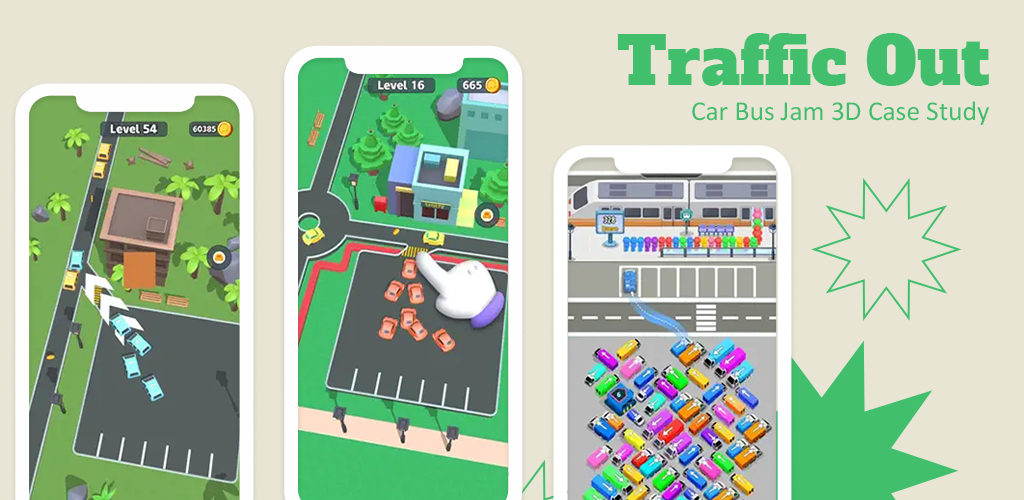
Our client designed Traffic Out: Car & Bus Jam 3D as a vibrant, hyper-casual traffic control challenge for iOS users. The game gives players the job of untangling busy intersections by directing cars and buses through real-time traffic congestion. The gameplay may seem easy at first, but it is powered by strong pathfinding logic and careful handling of collisions behind the scenes. The project was made in Unity and is meant to have clean graphics, strategic gameplay, and
User retention through satisfying game mechanics.
Business Goals:
The client's goals were explicitly centered on making a great casual gaming product that would last for a long time:
Release a traffic puzzle game on the Apple App Store that is visibly engaging and easy to learn.
Create hundreds of levels with escalating complexity.
Monetization with Unity Ads and in-app purchases.
Make sure that all iOS devices have a quick, smooth, and responsive experience.
Achieve high user retention through compelling level design and polished controls. Keep the file size small without losing visual quality.
Challenges:
This kind of mobile puzzle game has its own set of problems:
Real-time traffic control: Vehicles had to respond quickly with precise grid navigation using Unity’s physics and pathfinding systems
Scalable complexity: Starting with 4x4 grids and scaling to more intricate road mazes, level design needed to challenge without overwhelming
Optimized Performance: Maintaining 60 FPS on older iPhones required aggressive optimization
Non-intrusive Monetisation: Ads and IAP-based progression system had to enhance the player journey without frustrating
App size vs. visuals: Deliver crisp 3D assets while keeping the app size small
Save system: handling reliable offline progression with optional iCloud sync support.
Solutions Delivered
The whole project was made in Unity 6, which has real-time rendering and asset pipelines that work on mobile devices.
Core Game Architecture
Pathfinding and Grid System:
Used the A* pathfinding algorithm to determine the best paths in real-time, even when vehicles and buses are at the same intersection.
Using tile-based grid data, logic changes are dependent on impediments and exit conditions.
Vehicle Behaviour and Traffic Logic:
Employed Unity's NavMesh and custom steering logic to make Traffic flow smoothly and realistically, with no clipping or stalling. Buses used extended colliders to make sure that turns and avoiding were realistic.
Performance Optimisation:
Implemented static batching and LOD together for multiple simultaneous vehicles. Limited draw calls for earlier iOS devices with profiling tools Aimed for a steady 60 FPS.
Monetization and Analytics:
Rewarded video ads gave users suggestions and let them skip advertising without getting frustrated.
Interstitials showed up at key points between levels.
In-app purchases (IAP) let users purchase content packs and have an ad-free experience.
Unity Analytics kept track of user retention, engagement and level completion.
Level Data Management: The system stored level logic and data in ScriptableObjects and JSON. This made it lightweight, scalable, and easy to expand levels without slowing down the app.
Save System & Sync: For local storage, we used PlayerPrefs and SQLite. Players could also sync their progress with iCloud, which backs up their data across all of their devices.
UX/UI design Strategy
User experience was a key part of the development process. The interface was minimal, aesthetic and followed by Apple design standards for intuitive navigation.
One-tap Control: Players tap a vehicle and watch it find its way to the exit using smart visual cues
Directional Highlights: Clear indicators help players avoid gridlocks
Power-ups: Hints and skip levels available via earned or rewarded systems
Visual Feedback: Subtle speed-ups and glow effects on successful exits provide a sense of progress.
Adaptive Layout: Fully responsive for various screen sizes, including iPad aspect ratios
Art Style: Flat-shaded 3D visuals with colorful palettes and soft lighting for a clean look without visual noise
Process and Workflow
Workflow for Development
The game went through a well-planned manufacturing process:
1. Finding and Prototyping
Designed a proof-of-concept grid system and tried out the tap-to-move principles.
2. Assets and Levels Creation
Made 3D models of cars and roads, blending custom textures and modules from the Unity Asset Store
Developed and balanced more than 100 levels
3. Implementation of Gameplay Systems
Level manager, tracking progress, failure and victory states, and vehicle queue logic.
4. Setting up Monetisation
Set up rewarded ad systems, interstitial logic, and the IAP store
5. QA and Optimisation
A lot of testing on iOS devices with both Xcode simulators and real-world units
Improved loading times, animation mixing, and UI performance
6. Deployment
Optimizing the store listing with localized screenshots, keywords, and descriptions
Testing before launch using TestFlight, followed by a successful launch on the Apple App Store
Client Feedback:
The team appreciated Unity's grid and physics framework since it simplified prototyping and iteration. The monetization integration (advertising + hint system) generated sustainable revenue without hurting the user experience. They discovered that the iOS-only strategy provided better optimization and higher polish.
Conclusion
Traffic Out: Car & Bus Jam 3D is a great illustration of the efficient use of Unity with engagement-driven design and effective monetization. The game's effective pathfinding, performance tuning, and modular architecture made it visually appealing and scalable, resulting in user retention, growth potential and sustainable revenue.
User retention through satisfying game mechanics.
Business Goals:
The client's goals were explicitly centered on making a great casual gaming product that would last for a long time:
Release a traffic puzzle game on the Apple App Store that is visibly engaging and easy to learn.
Create hundreds of levels with escalating complexity.
Monetization with Unity Ads and in-app purchases.
Make sure that all iOS devices have a quick, smooth, and responsive experience.
Achieve high user retention through compelling level design and polished controls. Keep the file size small without losing visual quality.
Challenges:
This kind of mobile puzzle game has its own set of problems:
Real-time traffic control: Vehicles had to respond quickly with precise grid navigation using Unity’s physics and pathfinding systems
Scalable complexity: Starting with 4x4 grids and scaling to more intricate road mazes, level design needed to challenge without overwhelming
Optimized Performance: Maintaining 60 FPS on older iPhones required aggressive optimization
Non-intrusive Monetisation: Ads and IAP-based progression system had to enhance the player journey without frustrating
App size vs. visuals: Deliver crisp 3D assets while keeping the app size small
Save system: handling reliable offline progression with optional iCloud sync support.
Solutions Delivered
The whole project was made in Unity 6, which has real-time rendering and asset pipelines that work on mobile devices.
Core Game Architecture
Pathfinding and Grid System:
Used the A* pathfinding algorithm to determine the best paths in real-time, even when vehicles and buses are at the same intersection.
Using tile-based grid data, logic changes are dependent on impediments and exit conditions.
Vehicle Behaviour and Traffic Logic:
Employed Unity's NavMesh and custom steering logic to make Traffic flow smoothly and realistically, with no clipping or stalling. Buses used extended colliders to make sure that turns and avoiding were realistic.
Performance Optimisation:
Implemented static batching and LOD together for multiple simultaneous vehicles. Limited draw calls for earlier iOS devices with profiling tools Aimed for a steady 60 FPS.
Monetization and Analytics:
Rewarded video ads gave users suggestions and let them skip advertising without getting frustrated.
Interstitials showed up at key points between levels.
In-app purchases (IAP) let users purchase content packs and have an ad-free experience.
Unity Analytics kept track of user retention, engagement and level completion.
Level Data Management: The system stored level logic and data in ScriptableObjects and JSON. This made it lightweight, scalable, and easy to expand levels without slowing down the app.
Save System & Sync: For local storage, we used PlayerPrefs and SQLite. Players could also sync their progress with iCloud, which backs up their data across all of their devices.
UX/UI design Strategy
User experience was a key part of the development process. The interface was minimal, aesthetic and followed by Apple design standards for intuitive navigation.
One-tap Control: Players tap a vehicle and watch it find its way to the exit using smart visual cues
Directional Highlights: Clear indicators help players avoid gridlocks
Power-ups: Hints and skip levels available via earned or rewarded systems
Visual Feedback: Subtle speed-ups and glow effects on successful exits provide a sense of progress.
Adaptive Layout: Fully responsive for various screen sizes, including iPad aspect ratios
Art Style: Flat-shaded 3D visuals with colorful palettes and soft lighting for a clean look without visual noise
Process and Workflow
Workflow for Development
The game went through a well-planned manufacturing process:
1. Finding and Prototyping
Designed a proof-of-concept grid system and tried out the tap-to-move principles.
2. Assets and Levels Creation
Made 3D models of cars and roads, blending custom textures and modules from the Unity Asset Store
Developed and balanced more than 100 levels
3. Implementation of Gameplay Systems
Level manager, tracking progress, failure and victory states, and vehicle queue logic.
4. Setting up Monetisation
Set up rewarded ad systems, interstitial logic, and the IAP store
5. QA and Optimisation
A lot of testing on iOS devices with both Xcode simulators and real-world units
Improved loading times, animation mixing, and UI performance
6. Deployment
Optimizing the store listing with localized screenshots, keywords, and descriptions
Testing before launch using TestFlight, followed by a successful launch on the Apple App Store
Client Feedback:
The team appreciated Unity's grid and physics framework since it simplified prototyping and iteration. The monetization integration (advertising + hint system) generated sustainable revenue without hurting the user experience. They discovered that the iOS-only strategy provided better optimization and higher polish.
Conclusion
Traffic Out: Car & Bus Jam 3D is a great illustration of the efficient use of Unity with engagement-driven design and effective monetization. The game's effective pathfinding, performance tuning, and modular architecture made it visually appealing and scalable, resulting in user retention, growth potential and sustainable revenue.
Results
The game did better than expected, doing well both technically and commercially:
200+ levels were available at launch with regular updates
Received a rating of 4.6+ from thousands of positive user reviews
Intuitive gameplay and satisfying progression maintained high user retention.
Strong sessions and high engagement driven by rewarding retry cycles and smooth gameplay
Monetization:
Rewarded ads balancing with IAP purchases for bonus level packs and ad-free experience without harming engagement.
Smooth 60 FPS gaming on all platforms, from the iPhone 7 to the iPhone 15
Ready to scale?
Bring your next digital transformation to life.
Our experts can help you design, build, and launch software that improves efficiency and customer experience.
Contact Us